Sunday Dinner
“Do you think someone like you should be having children?”
My mother-in-law asked me that on a Sunday afternoon in March, while I was helping her set the table for dinner. I was standing on the little wooden step stool she kept by the china cabinet, the one Michael had bought for her kitchen the first year we were married so I could reach the plates. I had four of her good dinner plates in my arms, the ones with the blue rim, and I was three months pregnant.
I set the plates down very carefully on the counter beside me. “What do you mean?” I asked.
Patricia didn’t answer right away. She folded a cloth napkin into a neat triangle and laid it beside a fork. Then she glanced at my stomach, which was only just beginning to show under my sweater, and looked away again.
“With your condition, Sarah,” she said.
I’d heard that word all my life. Condition. Doctors said it, teachers said it, strangers in grocery stores said it while they stared. I’d learned a long time ago to let it slide off me the way rain slides off a window. But hearing it in my mother-in-law’s kitchen, about my baby, it didn’t slide. It stuck.
“Michael and I have discussed everything with our doctors,” I said. “We’ve had genetic counseling. I’ve seen a maternal-fetal medicine specialist at Ohio State since before we started trying. We know the risks.”
Patricia frowned. She set down the napkin. “Doctors don’t know everything,” she said.
Before I could answer, Michael came into the kitchen from the back porch, where he’d been fixing the latch on his mother’s storm door. He’s six foot one, and he had to duck a little under the kitchen doorway the way he always does in that old house. He looked at his mother, then at me, standing on the step stool with my hands flat on the counter.
“Everything okay?” he asked.
Patricia smiled immediately. A bright, warm, completely different smile, like somebody had flipped a switch. “Of course, sweetheart,” she said. “Just asking Sarah how she’s feeling.”
I wondered why she’d changed her tone so quickly. I wondered why she couldn’t say the same thing in front of her son that she’d just said to me.
I didn’t know then how far she would go to keep me from raising my child.
Chapter Two: Thirty Years
I was born with achondroplasia, the most common form of dwarfism. I’m three feet eight inches tall. My arms and legs are short, my head is a little larger than average, and my back has a curve in it that aches when it rains. My parents were both average height. Most people with achondroplasia are born to average-height parents. It happens by chance, a single change in a single gene, about once in every twenty-five thousand births.
I spent most of my life being treated like a joke.
In elementary school in Westerville, Ohio, the other children called me “doll” and “little freak” and asked if I lived in a dollhouse. They’d pat me on the head on the playground like I was a puppy. One boy in third grade picked me up and carried me around the cafeteria while everybody laughed, and the lunch monitor laughed too before she told him to put me down.
By high school, it was worse, because by then the cruelty had learned to be clever. In my junior year, the boys at Westerville North had a game. They’d dare each other to ask me to prom.
One of them actually did. His name was Kyle Prentice. He was tall and handsome and played lacrosse, and he stopped me at my locker in April and asked if I’d go with him. He said it so sweetly. I said yes. I went home and cried with happiness, and my mother took me to the mall that Saturday, and I spent the whole afternoon choosing a dress. Blue, with little silver beads on the bodice. We had it taken up at a tailor in Worthington.
On Monday, I found him at his locker to tell him the color so he could get a matching corsage. His friends were standing around him. When I said the word blue, they burst out laughing. Kyle laughed too. Then he told me, still laughing, that it was a bet. Fifty dollars. He said he couldn’t believe I actually thought he’d take me.
I never went to prom. The blue dress hung in my closet until I left for college, and then my mother gave it to Goodwill.
Adulthood wasn’t much kinder. It was just quieter. I got my degree in accounting from Ohio State and went to work at a credit union in Columbus, where I’m a senior financial analyst now. I bought a condo and had the kitchen counters lowered and lived a good, careful life. But some men rejected me the moment they saw me in person, after weeks of messaging online. Others treated my height as a curiosity, a novelty, something to tell their friends about. One man on a first date asked me, over appetizers, whether everything was “proportional.”
By thirty-five, I’d stopped believing anyone could genuinely love me. Not because I didn’t think I was worth loving. I’d made my peace with my body by then. I just didn’t think the world would ever let anybody look past it.
Then I met Michael.
Chapter Three: Michael
I met him at a friend’s fortieth birthday party at a brewery in the Short North, in October. He was standing by himself near the dartboard, holding a beer and looking like he’d rather be anywhere else. He was forty-two then, tall and handsome in a quiet way, with gray coming in at his temples and kind brown eyes behind wire-rimmed glasses. A civil engineer for the Ohio Department of Transportation, I found out. Bridges, mostly.
He came over and asked if I played darts. I said I’d never been able to reach the board. He laughed, not at me, but with me, and then he took the board down off its hook and leaned it against the wall at my height, and we played six games. I won four of them.
He asked me out the next week. On our first date, at a little Italian place in German Village, he pulled out my chair, and then he asked about my work. And he listened. He asked about how credit unions differ from banks. He asked follow-up questions. He told me about a bridge over the Scioto River he’d spent three years redesigning, and how it was the thing he was proudest of in his life.
He never mentioned my height. Not once. Not that night or any night after.
When he called the next morning, I almost couldn’t believe it. I sat on the edge of my bed with the phone pressed to my ear and listened to him ask if I was free on Saturday, and I had to put my hand over my mouth so he wouldn’t hear me crying.
We married two years later, at a little stone chapel in Granville, with forty people. Michael had the pastor stand on the floor instead of the raised platform so I wouldn’t have to look up at him while we said our vows. He never treated my body as something embarrassing or something to manage. When strangers stared at us in restaurants, he simply reached across the table and held my hand.
His mother was harder to understand.
Patricia Halloran was sixty-eight when I met her. A retired school secretary, widowed since Michael’s father, Gerald, died of a heart attack in 2019. She lived alone in the brick house in Upper Arlington where Michael grew up, with a garden full of roses and a living room full of photographs of her only son. She was polite to me. Always polite. But distant, the way you’re polite to a stranger in a waiting room.
At our wedding, she congratulated us without hugging me. She shook my hand. She hugged Michael for a long time, and then she shook my hand.
Whenever Michael mentioned wanting children, she changed the subject. She’d ask about his job, or the weather, or the Buckeyes. I assumed she worried about medical complications. I understood that. I had concerns myself.
Chapter Four: The Plan
Because of my body, pregnancy required careful planning. Women with achondroplasia can have healthy pregnancies, but our small torsos leave less room for the baby to grow, and our pelvises are too narrow for a vaginal delivery. Everything has to be watched. Breathing, as the baby gets bigger and presses up against the lungs. Blood pressure. Spine. Weight.
Michael and I met with a maternal-fetal medicine specialist at the Ohio State Wexner Medical Center before we ever tried. Dr. Adaeze Nwosu, who’d cared for more than a dozen women with skeletal dysplasias. We sat in her office for two hours. She talked us through every risk. The monitoring I’d need. Why a planned C-section around thirty-eight weeks would be safest. The anesthesia team who’d need to plan ahead, because spinal anesthesia can be harder with my spine.
Then we met with a genetic counselor named Ruth Abernathy. She explained that because I have achondroplasia and Michael doesn’t, any child of ours would have a fifty percent chance of inheriting it. One in two. A coin flip.
Michael held my hand under the table. “Does it change anything for you?” he asked me, in the car afterward. “Knowing that?”
I thought about it for a long time. About the third-grade cafeteria. About Kyle Prentice and the blue dress. About the man who asked if everything was proportional.
“If she’s like me,” I said finally, “she’ll have one thing I never had.”
“What’s that?”
“A mother who knows exactly what it’s like,” I said. “And a father who took the dartboard off the wall.”
Nothing was guaranteed. But we made the decision together, with our eyes open.
When I found out I was pregnant, at thirty-eight, I cried so hard on the bathroom floor that Michael came running and thought something was wrong. “Sarah? What happened? Are you hurt?”
I handed him the test.
He stared at it. He read the little window three times. Then he sat down on the bathroom floor beside me and started crying too.
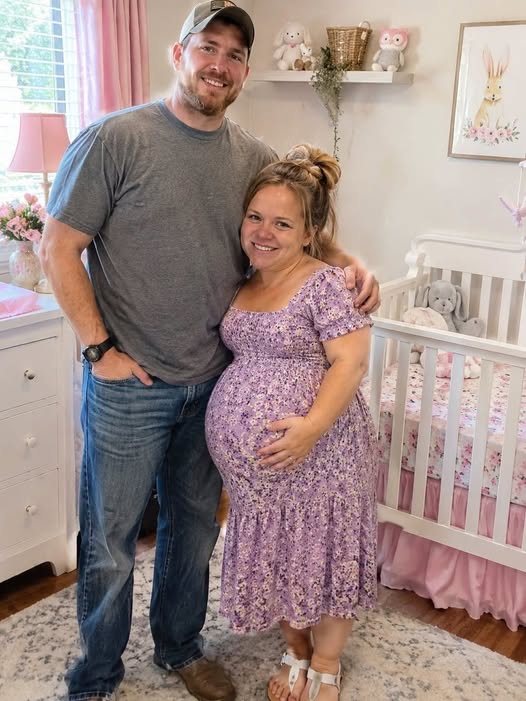
Michael attended every appointment he could. He took Thursday afternoons off from ODOT for six months. He assembled the crib himself and painted the nursery a soft pale yellow. He built a little set of wooden steps so I’d be able to reach the changing table. We chose the name Charlotte, after my grandmother, who taught me to read and never once in her life looked at me like I was anything but ordinary.
Dr. Nwosu monitored me every two weeks, then every week. The pregnancy progressed beautifully. My breathing got harder as Charlotte grew, and I couldn’t sleep lying down after thirty weeks, but my numbers were good.
But Patricia became more and more uncomfortable.