When Michael showed her the twenty-week ultrasound photograph at Sunday dinner, she barely glanced at it. She handed it back to him without a word. Then she said, “Are you sure this is a good idea?”
Michael frowned. “Mom,” he said. “We’ve been over this.”
“I’m only concerned.”
“Then ask how Sarah’s doing,” Michael said, “instead of questioning whether we should have a child.”
Patricia didn’t say a word for the rest of dinner.
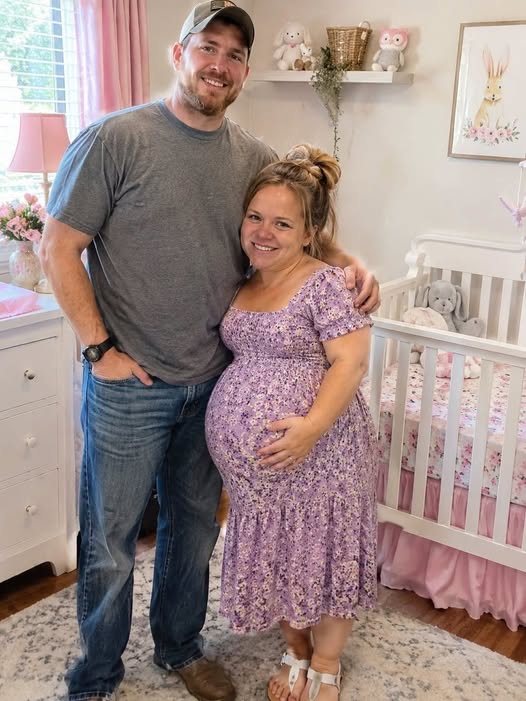
At six months, she visited our house in Clintonville for the first time in a year. She walked down the hall to the nursery and stood in the doorway looking at it for a long time. The pale yellow walls. The white crib. The little wooden steps beside the changing table. The rocking chair in the corner with a quilt my mother made folded over the arm.
“You’ve certainly bought a lot,” she said.
“Babies need things,” I said.
She walked over to the crib and touched the rail with one finger. “People get attached to plans that don’t always work out,” she said quietly.
I asked her what she meant. She said she was only being realistic. Then she went back to the kitchen and asked Michael about the Buckeyes.
Chapter Five: The Lunch
At seven months pregnant, Patricia invited me to lunch.
She called me at work on a Tuesday, which she’d never done. She asked if I could come to her house on Thursday. Michael would be at a bridge inspection in Zanesville, she said, so she’d specifically like me to come alone. Just the two of us.
I hoped she wanted to repair our relationship. I hoped, I’ll admit it, that she’d finally decided to love her granddaughter. I put on a nice blue maternity dress, and I picked up a little bouquet of tulips at the Kroger on the way.
When I arrived, she had tea waiting on the dining room table, in her good china cups. Chicken salad sandwiches with the crusts cut off. She thanked me for the tulips and put them in a vase. Then we sat across from each other at that long dining table, my feet dangling from her tall chair, and made small talk for several awkward minutes. My job. Her roses. The weather.
Then Patricia got up and disappeared into the den.
She came back carrying a white envelope. She sat down again across from me and laid it on the table between us.
“I’ve been thinking about your situation,” she said.
“My situation?”
She slid the envelope across the table. I opened it. Inside was a check. Drawn on her account at Huntington National Bank. Pay to the order of Sarah Halloran. One hundred thousand dollars. In the memo line, in her neat school-secretary handwriting, she’d written: For Charlotte’s future.
I stared at it. “What’s this for?”
Patricia folded her hands on the tablecloth. “When the baby is born,” she said, “leave it at the hospital. I’ll arrange everything.”
I stared at her across her dining table. For a moment, I honestly didn’t understand the words. They just sat there in the air between us like they were in a foreign language.
“You want me to abandon my child,” I said slowly.
“Think of it as giving the baby a better life,” she said.
“Are you offering me money to give up Charlotte?”
“I’m offering you a chance to do what’s best for her,” Patricia said. Her voice was calm. Reasonable. Like she was explaining a school schedule to a confused parent.
“She’s my daughter,” I said.
“That doesn’t necessarily mean you’re the best person to raise her,” Patricia said.
I pushed the check back across the table to her. My hands were shaking.
“Get out of my life,” I said.
Patricia picked up the check. She folded it once, carefully, and put it back in the envelope. “Then don’t say I didn’t warn you,” she said.
I struggled to get down from her tall dining chair. At seven months pregnant, with my center of gravity gone and my back aching, it took me a long time. She didn’t help me. She sat there and watched.
“Don’t contact me again,” I said, when I finally got my feet on the floor.
“You’re being emotional, Sarah,” she said.
“No,” I said. “I’m being clear.”
I left before she could say anything else. I walked out her front door and down her brick front steps one at a time, holding the railing, and got into my car. The seat was pushed all the way forward and the pedals had extensions on them, the way they’ve been on every car I’ve ever driven.
Then I sat there in her driveway gripping the steering wheel with both hands.
I’d heard cruel things about my body for thirty years. In cafeterias and hallways and grocery stores and restaurants. But nobody, not once in my whole life, had ever suggested I should surrender my child because of it.
Chapter Six: Silence
When Michael came home from Zanesville that night, I told him everything. I was sitting in the rocking chair in Charlotte’s nursery when he found me. I’d been sitting there for four hours.
He stood in the doorway in his ODOT polo shirt with his hard hat still in his hand, and he listened to the whole thing. When I finished, he looked stunned. Like somebody had hit him.
“She offered you how much?” he said.
“A hundred thousand dollars.”
“And she said to leave Charlotte at the hospital?”
I nodded.
Michael reached for his phone in his back pocket. His hands were shaking. I’d never seen my husband’s hands shake.
I stopped him. I reached up and put my hand on his wrist. “Please don’t call her while you’re this angry,” I said. “Please. Not tonight.”
He looked at me for a long moment. Then he put the phone down on the dresser and sat down on the floor beside the rocking chair, so we were eye to eye. He took both my hands.
“She’s never coming near our baby,” he said. “Never.”
For once in my life, I didn’t try to soften his words. I didn’t say she’s your mother. I didn’t say she’s just worried. I just held his hands and let him say it.
Michael called Patricia the next morning, from the kitchen, before he went to work. I listened from the hallway. He told her that what she’d done was unacceptable. He said he didn’t care what her reasons were. He told her she wasn’t welcome in our home, and she wasn’t welcome at the hospital when the baby came, and if she showed up, he’d ask security to remove her.
Patricia said something I couldn’t hear. A long something.
“Help whom?” Michael said. His voice was very cold. “Help whom, Mom?”
He hung up.
For the rest of my pregnancy, we didn’t speak to her.
She sent a birthday card to Michael in May. He threw it away without opening it. She called him four times in June. He didn’t answer. His aunt Margaret, Patricia’s sister in Dayton, called him in July and said his mother was beside herself and wouldn’t explain why. Michael told his aunt it wasn’t his story to tell.
At thirty-six weeks, I folded Charlotte’s clothes into the drawers of the white dresser. Tiny onesies. Tiny socks. A little hat my mother knitted. At thirty-seven weeks, Michael installed her car seat in the back of his Subaru and had it checked by a firefighter at the station on North High Street. Dr. Nwosu scheduled my C-section for a Thursday morning in August, at thirty-eight weeks and four days. We kept my hospital bag packed by the front door.
Three days before the scheduled delivery, I woke at two in the morning with contractions.
Chapter Seven: Charlotte